Constantin, EasySubmits founder
Quick answer
To increase domain rating, focus on earning relevant links to a useful website and monitor the backlink profile over time. Check the starting score, find worthwhile opportunities and judge the work by visitors and product use as well as the metric.
Understand what domain rating measures
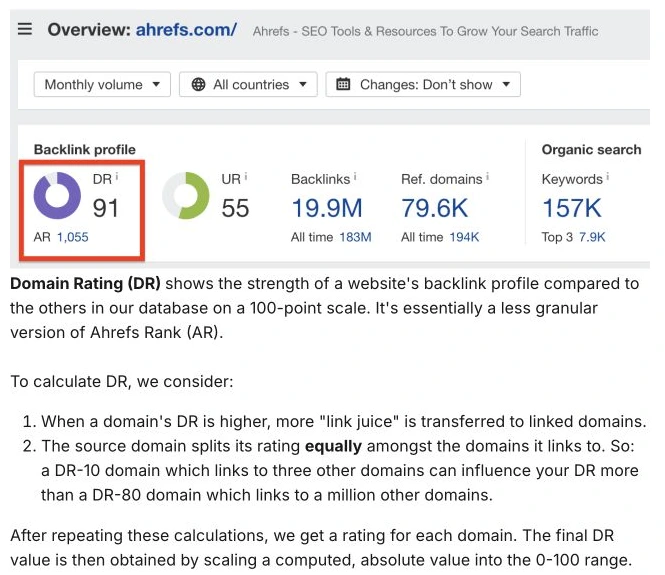
Domain Rating is an Ahrefs metric for the relative strength of a domain’s backlink profile. It uses a scale from zero to one hundred. Ahrefs’ explanation of DR describes how linking domains and the distribution of their links affect the calculation. That is different from a complete assessment of the website’s content or business.
The practical consequence is that a score needs context. Two sites can have similar DR and very different audiences, content quality and conversion rates. A domain with a strong link profile can still have an unhelpful landing page. A new site with little backlink history can have a product people value and a clear path to finding its first customers.
Keep DR separate from Moz’s Domain Authority. They are different metrics from different providers, with different inputs. Our tool reports Ahrefs DR. Do not compare a DA value from one website with a DR value from another as if they were the same measurement. Label the provider in your tracking sheet.
Use the metric to ask a question, not to close the discussion. If a competitor has a stronger backlink profile, investigate the kinds of useful pages and relationships behind it.
Record a baseline before adding links
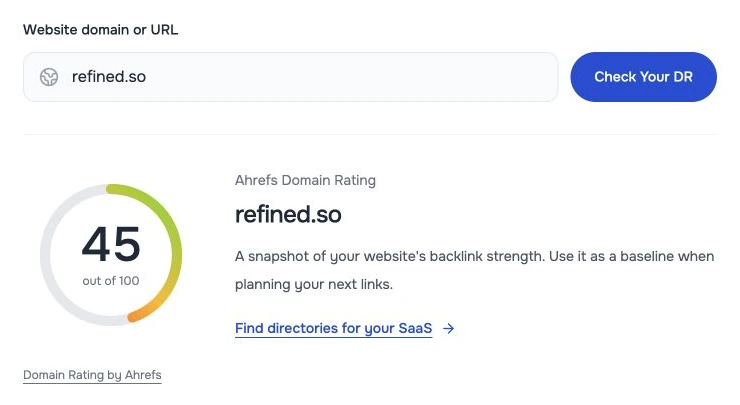
Use the free domain rating checker to record your current Ahrefs score with a date. If you are reviewing several domains, the bulk domain rating checker puts a small batch in one table. Keep the provider and check date alongside each result so later comparisons are understandable.
Write down what else you know about the site. Useful context includes whether the domain is new, which pages receive referrals and whether your public product URL has changed. A score alone cannot tell you why a change happened. Keep a note of major site moves, new content and relevant mentions without assuming any single event caused the next measurement.
Choose a sensible review interval rather than checking after every form submission. A directory must first publish a listing, and a data provider must discover and process the link.
Record business outcomes alongside the benchmark. For a SaaS product, that might mean qualified trial starts or people completing a useful workflow. If a listing sends suitable users but DR remains unchanged, the listing can still have value. If DR increases without a useful visit, investigate the difference rather than treating the number as a finished acquisition strategy.
Keep a simple change log with the observation date, the actions your team completed and any pending third-party review. Include the live URLs you can verify. That record makes a later discussion much clearer than a screenshot of a score alone, especially when different people handle content, directory forms and customer acquisition.
Make a page worth linking to
Start with something another person would find useful enough to reference. That could be a clear explanation of an industry task, an original dataset you are allowed to publish, a small free tool or a template that saves repetitive work. Choose something your intended customers need, not a generic asset created only to attract any possible link.
Make the resource accessible from a stable URL. Explain what it does, how to use it and where its limits are. A template should include enough instructions that someone can apply it without contacting you. A tool should give understandable results and errors. Remove the friction that prevents a visitor from judging whether the page deserves a reference.
If you publish data, describe the collection method and the date. Distinguish your observations from estimates and borrowed claims. A small transparent dataset is more defensible than an impressive chart with no explanation. Avoid inventing a survey, test result or success story because it makes the page sound more authoritative.
Connect the resource to your product naturally. For example, a submission service can provide a useful directory list and a guide to preparing accurate listings. The resource answers a real task, and the paid service offers help with related work. A visitor should understand both without encountering a forced sales pitch after every paragraph.
Find links where your audience already looks
Look for public resources that list products like yours, communities that discuss your use case and partners who genuinely use the software. Relevance begins with the visitor’s task. A directory of accounting tools can make sense for an invoicing app; a directory chosen only for a large domain score may not.
For listings, use our SaaS directories, startup directories or AI directories according to the product. Read the entry criteria and inspect existing pages before submitting. Do not assume that inclusion in a list means every destination accepts your app or that every link will have the same attributes.
For relationships beyond directories, consider where the product already has a legitimate connection. An integration partner may maintain documentation or a supported-app catalog. A customer may want to describe a workflow. A relevant publication may need a concrete example for an article. Offer useful information and let the other party decide whether it belongs on their site.
Keep outreach specific and honest. Explain the resource and why it may help that audience. A useful professional relationship is more durable than an arrangement designed only around a score.
Evaluate directory links separately from domain scores
A directory can have a large DR while the individual listing is hard to find, incomplete or irrelevant. Open the listing page and inspect the actual product link. Check where it points, whether it redirects and whether the surrounding description helps a visitor. Domain-level metrics do not replace that inspection.
Link attributes matter too. A standard listing, a sponsored feature and a user-submitted comment may be treated differently on the same website. Google’s outbound link guidance explains attributes such as sponsored and nofollow.
Our directory link building guide gives a selection workflow. Keep one column for audience fit, another for the published listing and another for the backlink benchmark. That separation helps you explain why a niche directory made the shortlist even if its score is smaller than a general site.
When you pay for placement, identify what you are buying. A clearly labeled advertisement is different from an independent editorial recommendation. Do not ask a publisher to disguise sponsorship or change a link attribute to satisfy a metric goal.
Choose backlink work with clear deliverables
Ask what links will be created, whether the pages have a relevant audience and how the provider documents the result.
Google’s spam policies discuss link schemes and low-quality directory links. Use that guidance when someone proposes large volumes of unrelated placements or payments aimed primarily at manipulating search visibility. More links are not automatically better, and a vendor score should not override a poor explanation of the work.
Avoid submitting the same misleading description everywhere. An accurate category and a useful listing are better than keyword stuffing or an unshipped feature presented as available. Use the directory listing SEO guide to keep the factual details consistent while adapting the wording to each audience.
If you already have questionable links, do not make a drastic removal decision based only on DR. Investigate the source, the relevance and any concrete search issue. Keep notes so you can distinguish known events from speculation about what an algorithm might have done.
Maintain your listings and review the broader result
Once a listing is published, verify the name, URL, category and pricing details. Keep the account owner and edit route in your submission tracker. Products change, and an old listing can send visitors to the wrong page or describe a feature that no longer exists. Maintenance is part of making the reference useful.
Measure referrals over a longer period than launch day. Look for actual engagement with the product and the questions visitors ask. If people arrive from a relevant directory but fail to understand the offer, work on the landing page and onboarding. Another set of links may not solve the problem you observed.
Check DR on a consistent schedule and compare it with the earlier baseline. A relative score can move as the provider’s wider dataset changes, even when your team has done little new work. This is another reason to keep business measures beside the benchmark.
Decide the next action from the evidence. Maintain a listing that brings suitable visitors, improve a resource that people find useful, and stop paying for work with no clear deliverable.
Questions and answers
Earn relevant links to useful pages and review the backlink profile over time. Start with a baseline, improve resources people can reference and track actual published listings.